Vmware Display Drivers For Mac
MacOS High Sierra 10.13 Image for VMware mac OS High Sierra brings new forward-looking technologies and enhanced features to your Mac. New technologies at the heart of the system make your Mac more reliable, capable, and responsive — and lay the foundation for future innovations. Mac OS high sierra VMware image also refines the features and apps you use every day.
Mac Os Vmware Resolution
It’s macOS at its highest level yet. VMware Unlocker for all versions of VMware —- version of VMware 10 and below or version of VMware 11 and above. System requirements: 0. Download VMware Unlocker 2.1: 1. Intel processor with hardware virtualization support 2. From 1 GB of RAM (2 GB or more is recommended) 3. The program WinRar, 7-Zip or analog 4.
VMware Workstation or VMware Player of the current version (it is possible to work on previous versions of the program) Description: VMware virtual machine with macOS installed. Before you start working with the machine, be sure to apply as administrator VMware Unlocker. The necessary screen resolution must be installed automatically according to the settings of the computer on which the virtual machine is started. The other parameters (the number of CPU cores, memory, etc.) should be selected according to your equipment. Before running, we check the compatibility of the hardware with this program. ( Download: ADMINISTRATOR’S ADMINISTRATOR PASSWORD: 123 To start the machine, the processor must support virtualization and D.E.P If virtualization and D.E.P are disabled, enable them through the BIOS. It is recommended to run VMware Player to reduce the brakes Warning!
For the correct and full tuning of the machine, use the program VMware Workstation, not VMware Player Attention! This image is designed to work with the 14th version of VMware Workstation. Applications for OS X that require 3D acceleration (OpenGL) are not possible due to lack of necessary drivers. A single video player that plays video in this assembly is Movist, in others only sound without image. As the ⌘ (Command) key, the ⊞ ( Windows) Switching the keyboard layout is configured for ⌘ + Space (blank) If errors occur, read the information under the spoiler “Errors that occur when running OS X in VMware Workstation”. The iMessage startup guide can be found here (Installation Method 1. Install or VMware Player.
Unpack macOS High Sierra By SadeemPC.7z 2. Apply on behalf of the administrator a patch from the archive of VMware Unlocker (see the line Tablet in the topic header) 3. Open the macOS High Sierra.vmx file through File- Open 4. Configure the virtual machine for your hardware. Set screen resolution 1. In the Virtual Machine Settings, set the Auto-detect option or manually assign the desired resolution and save it.
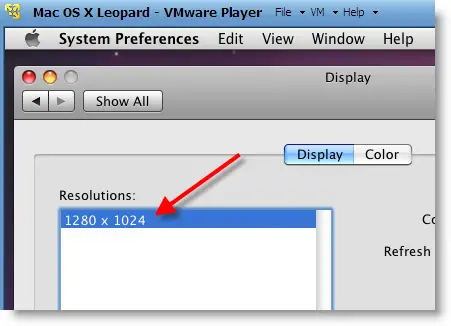
Run the Mac OS. In the System Settings – Monitor – Scaling – the permission you need appears.
Instead of point 2, you can select the item “best for the monitor” in System settings – Monitor Connecting USB 3.0 devices 1. Download and unpack the archive I Have put the file GenericUSBXHCI.kext Download: Manually in the folder System / Library / Extensions /. Next, with Kext Utility, you need to restore the rights to the Extensions folder.
Vmware Graphics Driver Mac Os X
In the virtual machine settings, in the USB controller section you need to set compatibility with USB 3.0 pic 3. After that, try to connect the device MacOS High Sierra Info: Year of manufacture: 2017 Version: 10.13 (17A365) Developer: Apple Inc. Developer’s site: © Apple Inc. Platform: Intel with SSE4.2 support (can be started on the CPU with SSE4.1), for AMD there is an instruction for the FX-series Language: multilanguage ADMINISTRATOR PASSWORD: 123 Download Links.
The comes with several improvements and changes. It could be the major update to original 10.10 rather than 10.10.1 and 10.10.2 updates. New Photo app, New Emoji, more iCloud options, Google 2-step verification and more changes are included in the OS X 10.10.3 update.
While writing this post, the update is available as public beta only, but surely this method will work for final version too. The had been used for this demonstration purpose. How to Update Mac OS X 10.10.3 on VMware Workstation Upgrade can be done with combo or individual updates. Better check the requirements, that means which earlier version is required for particular update. Usually the combo update will have the all necessary previous updates from the major release which is Mac OS X 10.10 Mavericks. 1) Make sure you are having the Mavericks OS X on the VMware workstation which is installed with Vanilla kernel.
Vmware Vga Driver Mac Os X
You can refer. It was upgraded from. You will be needing to to be able to install and use Mac OS X as guest Operating Systems on VMware with Windows 8.1 or Windows 7 computer.
Here is the OS X version of 10.10.2 before the update. 2) Take a before proceeding the software update. 3) Use Apple App store to download and install the 10.10.3 Yosemite on VMware. The virtual machine needs to be restarted to continue the installation. Obviously the guest OS should have internet access to download the software update. 4) As we said earlier, since the vanilla kernel had been used in the method without modifying or patching the original kernel, the software update will take place smoothly.
Here is the updated OS X 10.10.3 on VMware workstation on Windows 8.1 host computer. Recommended Guides: How to Fix Display, Slow OS X and Screen Lagging Issues On Yosemite VMware There are some tweaks and workarounds available to fix the display issues when using this Hackintosh method on VMware workstation. Few users complained about screen lagging and very slow performance of virtual machine. Here are the few workarounds that could possibly fix the slow performing OS X virtual machine issue and improve the display performance. A) Using Beamoff at startup It’s a kind of script developed by Hackintosh experts to make the Yosemite virtual machine work better in VMware workstation, VM Player and even on ESX server. You can download the about how to use beamoff on VMware virtual machine.
Here is the simple summary. A.1) Download the beamoff and extract it. Make sure you have transferred the file inside the guest OS X. A.2) It doesn’t need to be installed.
This particular file should be added in startup of Yosemite OS X for the specific user. You can find further Once you have added, it should be like below. Restarting the Mac OS X 10.10.3 virtual machine after above changes will load the beamoff in the startup and help to solve the display and lagging issues in VMware workstation.
B) Installing the Latest VMware tools VMware tools for Mac OS X guest on Windows host is not available since it doesn’t support Mac OS virtualization on Windows OS platform. But we can use the VMware tools which built for Mac OS X platform. Since the guest OS is same, installing the latest version of VM tools will help to some extend. B.1) Download the latest VMware fusion tools for Mac OS X. B.2) Extract the file inside OS X virtual machine. You will be finding darwin.iso inside “payload” folder.
Execute the ISO file and install the tools in the guest virtual machine. With the above two methods, mostly the display lagging and slow VM performance issue will be fixed on Mac OS X 10.10.3.
Hope this guide would be useful to run the latest version of OS X 10.10.3 on VMware workstation with Windows 8.1 or Windows 7.