Byword: Distraction-less Writing App For Mac
If only all of our writing environments were like this This is part of the Series. Update – I’ve built my dream desktop publishing app: So you’ve decided that you’re not someone who wants to because of the possibilities of losing data and you’re not interested in blogging in one of these that sync to your blog because of the cost or complexity. Perhaps you’re one of those writers who need something a little less robust – a little less distracting? You’re in luck! There are a number of desktop apps that do just that and we’ve seen a significant rise of apps that help you simply focus on that which is of utmost importance: Writing. These apps were designed to help you focus on the complete writing experience as best as they possibly can, removing distracting buttons, going fullscreen to just the drafting area, and even playing music in the background to help stimulate creative energy!
I’ve collected apps for Windows, Mac, Web, and more. Remember, these apps do not necessarily connect directly to your blogging platform (unlike these ) so you’ll have to, at some point, manually. Desk App Desk App is my very own writing and blogging app that I’ve built after years of building software and publishing content. It’s the combination of my two great loves and it was built for the digital publisher distinctly! I hope you enjoy it!
Clearly it’s winner in my book! So pretty so calming so perfect.

Ommwriter is one of the more well-known Mac (and now iPad and Windows!) apps that has definitely inspired many a copy-cat. With support for multiple backgrounds, different sound effects and music, you might never leave the interface! Nothing but text. Q10 I liken as the Ommwriter for Windows since you’re able to do fullscreen, except there are some really neat features in Q10 like spellcheck and timed writing sessions. Definitely a must-have. tentblogger-vimeo 24156534 3. IA Writer This will cost you a few pennies but it’s well worth the expense if you dive in deep.
Above is a sweet video of it in action! If you want to read my robust review of than check this one out here. PenZen This might be one of the – simply begin to type and you’re good to go! Save via PDF directly if you like (check out the example of my work above in PDF format ).
Yup, it was that easy. This is much more than just a writing app 5. Ulysses is much more than just a focused-writing app – it’s a full suite of awesomesauce for all your writing and creative needs. It’ll cost you some green but man, it’s crazy-powerful. But, it does have a full-screen mode so it’s made the list.
Clean and straight-forward. WriteMonkey This is another minimalist app which even has CSS markup support if you want. I can’t believe this app is free considering some of the features built right in. One of my favorites! WriteRoom might be one of my personal favorites for the Mac since it’s one of the fastest and cleanest app of them all. There’s not much to it and the simplicity of it is astounding. And that’s about it.
Byword This which pretty much puts it near the top of the pile. Clean and sleek. Clean Writer, another Mac app which starts at $3, is a sweet deal if you’re looking for a stripped down workspace with a few styling and theme options. Writer App A this app competes directly with Clean Writer above.
It’s also priced the same as well. Grandview This takes minimal writing to the next level and lets you just see one word at a time! Sure, you can step back if you want with this app but I find this experience fascinating. FocusWriter This might just be the best thing for you since it’s free and does most of what you might need. With optional statistics, auto-save, and more you can’t beat it for the price of zero. Microsoft Word I thought I might mention this even though it’s not really classified as a minimal writing app – but you can do fullscreen with it if you like. It’s not the same experience though.
QuietWrite This free web app is super impressive as it allows you to have that fullscreen experience with auto-saving. It’s perfect for bloggers since it gives you that title field too! You can save them and come back to them later! Pages App It’s also worth noting that allows fullscreen too. You could use this if you wanted if you already have the app. Love me some java! JDarkRoom is a multi-platform app that uses Java to run.
It’s free to use and might be a first app to try because of the nice cost. Dark Room This is the Windows-version of WriteRoom and is free to use. Also a great spot to start since the cost is so low. A word processor with fullscreen mode.
Bean App is actually a free word processor for the Mac and there’s a nice fullscreen mode that’s comparable. It’s a good Pages and Word replacement and worth a look and mention on this post.
The Ommwriter for Windows 19. CreaWriter was inspired by Ommwriter and is the Windows-version comparable. It’s free but you can pay for increase features if you’d like. Definitely worth a look.
Writing with Python. PyRoom Distraction-free writing? Sure, as long as you have Python, for python. Writer Web App is an “internet typewriter” in your browser. Print, download, and count the words. Google Docs Of course, I have to mention the free (and awesome) option with fullscreen that might just be what you need.
TextEdit As I just love OS X’s native application. It’s not a “true” minimalist app but it does the trick.
TextRoom This for all operating systems is pretty darn sweet. Works on Windows, Ubuntu, Fedora and other Linux distributions. Open Office Of course if we mention Microsoft it wouldn’t be fair if we left out the free alternatives to those robust collection of apps, right? Is the free version of the many Microsoft-branded productivity apps, including one for writing. It’s like the ‘Office’ without the Microsoft part. NeoOffice Another free “office-like” alternative this one’s made for the Mac.!
And that’s it! Is there anyone that I’ve missed?
What do you use? This is part of the Series.
. Pros Distraction-free writing app with support for Markdown language.Supports direct publishing to popular online sites.
Good export options. Cons No library or tools for reference materials. Not ideal for long-form writers. Lacks templates.
Solutions to common technical problems require macOS Terminal. Bottom Line Byword, an inexpensive writing app for Mac and iOS, publishes your work directly to Medium, WordPress, and other platforms.

It's not ideal for long-form writers, however. Writers have different needs, depending on their writing process, what they write, and where they intend to publish it. These points are considerations when. The Mac and iOS app Byword works reasonably well for writers who prefer a distraction-free writing environment, as well as those who produce shorter works and publish online. We've identified two Editors' Choice writing apps, Scrivener and Final Draft.
Scrivener isn't in the distraction-free category, however. Its interface more closely resembles that of a word processing app. But it has places to keep notes on characters, plot, story, and more. Final Draft is the best option for working screenwriters, as it helps you format scripts to industry standards for professional production.
Price and Platform Byword is only available for Mac and iOS. The Mac app costs $11.99, and the iOS app costs $5.99.
While the iOS app price sounds high, it helps to think of the two as a package deal for about $18. Those prices are one-time fees. There are no subscriptions or other recurring charges.
You pay once, and you own the software forever. Byword is very fairly priced. The app is perhaps most similar to, which charges $9.99 for its Mac app and $3.99 for the iOS app. IA Writer comes out only a few dollars cheaper. Is another close competitor because, like Byword, it sticks to a distraction-free interface.
WriteRoom costs just $9.99, but it doesn't have a mobile app at all, so you can't edit your writing or make notes on the go. At $44.99, costs significantly more, but as mentioned, it has more features and is therefore more versatile. Its iOS app along costs $24.99. For both apps, you end up paying about $70. As with Byword, these are one-time fees. Once you pay for the software, you own it for life. Ulysses isn't the only app in the $45 to $75 price range.
Storyist sells for $59, and its iOS app sells separately for $14.99. Scrivener costs $45, plus $19.99 for the iOS app. One benefit of Scrivener, however, is that it has apps for both macOS and Windows. A single purchase of either the Windows or Mac app comes with permission to install the app on as many computers in your household as you want. The most expensive writing app I've tested (available for Mac and Windows). You really don't need to spend $249.99 on a writing app unless you are a professional screenwriter, as the key benefits of Final Draft have to do with its ability to conform to the standards of that industry. (If you're a broke writer still trying to break into the screenwriting business, save some money and use screenwriting templates found in Scrivener or Storyist instead.).
Another app that can get expensive is, because it's sold as a subscription web app for $9.99 per month. Adobe Story is also aimed at professional screenwriters, but it is even more specialized than Final Draft. It's best for writers who also have a hand in the production side of movies and television (think scripted documentaries), or at least work extremely closely with those who do. As you may have noticed, many writing apps are for Mac only, with only a few offering a Windows version. They include Scrivener, Final Draft,. YWriter happens to be free.
There are two versions of the app, yWriter 5 and yWriter 6, and they are functionally the same. The difference is that yWriter 5 is designed for Windows XP and later, as well as Linux. YWriter 6 is the same app optimized for Windows 8 and 10. Getting Started As a distraction-free writing app, Byword supports the language Markdown. Markdown is a way to add formatting to text without using menus and options, which keeps the interface clear of any distractions. With Markdown, you can add bold, italics, heading formats, and other styles to your writing by typing codes right in the text.
For example, if you've ever sent a text message and used asterisks to make a word bold (like.this.), that's Markdown. Markdown isn't perfectly uniform across apps where it's used. In some apps, for example, asterisks around text means boldface while in other apps it means italics. Byword shows you how the text will look once it's exported and formatted, making it easy to know whether you've coded your text correctly. If Markdown sounds intimidating, it's not.
It's simple to learn given just a good cheat sheet, because there are only a handful of codes. Byword links to a table with Markdown codes so that you can easily reference it online. If you really don't want to learn Markdown, you can alternatively apply a limited number of styles using the Format menu in Byword. Bold, italic, bullets, numbered lists, indents, and a few other styles are included. When you first start a document in Byword, the app offers to save it to iCloud. As mentioned, saving to iCloud or another allows you to sync your writing and get at it from your iOS device as well as your Mac.
Another option when you save files is to tag them, although you tag them at the macOS level, not the app level. In other words, you can add the standard macOS color-coded tags. Other apps let you create custom text-based tags inside the app itself. When writing in Byword, you can change the View mode to help you focus on your text in different ways. For example, a Paragraph view puts only the active paragraph text in full brightness. The Line view puts only the active line in full brightness. Typewriter mode locks the focus on the center of the screen, scrolling completed lines up and out of the way.
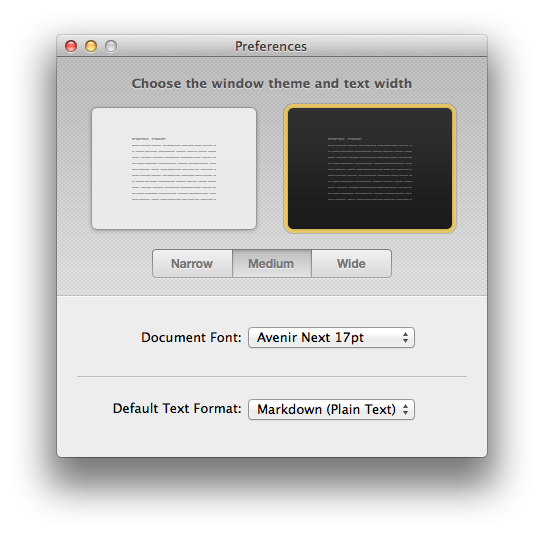
There's also a Full-Screen mode that takes over your entire screen with nothing but text and very wide margins. These modes are fairly standard in most writing apps. In addition to customizing the view, you can also change the theme to be either light or dark. You can also change the page width as well as the typeface and text point size. Saving, Exporting, and Publishing. Byword keeps a history of your documents, allowing you to revert to a previous version, but it only saves a copy when you close the document or manually save it. I wish it had an auto-save option at different intervals, such as every minute or every five minutes.
As you create new files, they save to whatever service you designate. You can only see all your files as a list in a Finder window. You cannot see a list of files from within Byword. With other writing apps, this isn't the case. Many writing apps, including Scrivener, Ulysses, and Storyist, provide a library, usually on the left side and often collapsible in case you want to hide it. The library view lets you organize pieces of writing into different folders or sections by dragging and dropping them.
Another advantage of having a library is that you can quickly switch from one chapter or section to another without keeping too many windows open at once. When working on long-form writing, such as a book, it helps to be able to rearrange the order of sections and chapters at will. Byword doesn't offer anything like this. Byword also doesn't contain any tools for crafting a story, such as storyboard, character sheets, outline, and so forth. Again, long-form writers typically need these materials at their fingertips to keep their work organized and moving forward. It also doesn't have any way to track how much you write each day, or keep an eye on your progress over time.
Other apps that are more attuned to the needs of long-form writers, such as Ulysses and Scrivener, offer ways for you to set goals and track them. Although Byword isn't ideal for long-form writing, it is much more adept at supporting shorter pieces of writing, especially those you intend to publish online. With Byword, you can set up the app to export your files directly to Medium, WordPress, Tumblr, Blogger, and Evernote. The app supports a good number of export formats as well, including HTML, LaTeX (commonly used in academic publishing), RTF, PDF, and Word. Byword doesn't come with templates, as many other writing apps do. Templates generally help you format a specific type of writing, whether a screenplay or a novel.
If you've never written a novel and submitted it to a publisher, you might not know all the front matter that's typically included, and a template can guide you. Scrivener and Storyist both have an excellent array of templates. I didn't run into any major problems testing Byword, and I'm glad I didn't because from the look of most technical problems are resolved using the macOS Terminal. The instructions are written clearly enough, but people who are not especially technically minded will not be happy to fire up the Terminal and resolve issues using code. Good for Publishing Short Works As an inexpensive and distraction-free writing app for Mac, Byword is comparable to iA Writer and WriteRoom. None of these three apps stands head and shoulders above the others, although they all have something that makes them unique.
Byword Distraction-less Writing App For Mac
Byword's strength is its ability to export and publish directly to WordPress, Medium, Tumblr, and Blogger and to save to Evernote. For writers who compose reasonably short pieces for the web, it's a good tool. Writers who need libraries, templates, goal-tracking features, and the ability to create reference materials should pay more for an app that caters better to their needs.
Scrivener and Ulysses are the two Editors' Choices, with Ulysses offering a more distraction-free experience and Scrivener providing an interface that's closer to a word-processing application.